
By synthesizing physiological, anatomical, life-history, and genomic datasets with predictions from population genetics, I aim to develop an integrative framework for studying phenotypic evolution across deep time.
Phenotype at a Glance: Key Findings
Across linked projects, the strongest recurring pattern is that complex phenotypes evolve through interacting shifts in behavior, morphology, and population history, not through single-trait change alone.
- Cotingas: A six-locus phylogeny spanning 61 species across all 25 genera (~7,500 bp) resolved key relationships and found no broad-scale support for a simple polygyny-driven model of sexual dichromatism.
- Bee hummingbirds: A 35-species analysis detected multiple abrupt shifts in acoustic mechanisms (at least six major saltational changes), negative phylogenetic association between wing trills and singing, and repeated losses of learned song.
- White-crowned manakin complex: Integrated genomic and phenotypic data support deep structure across the Neotropics, including 14 vocalization types and evidence for at least 8 diagnosable lineages, with potential diversity as high as 15–17 species.
Sexual Selection: Neotropical Cotingas
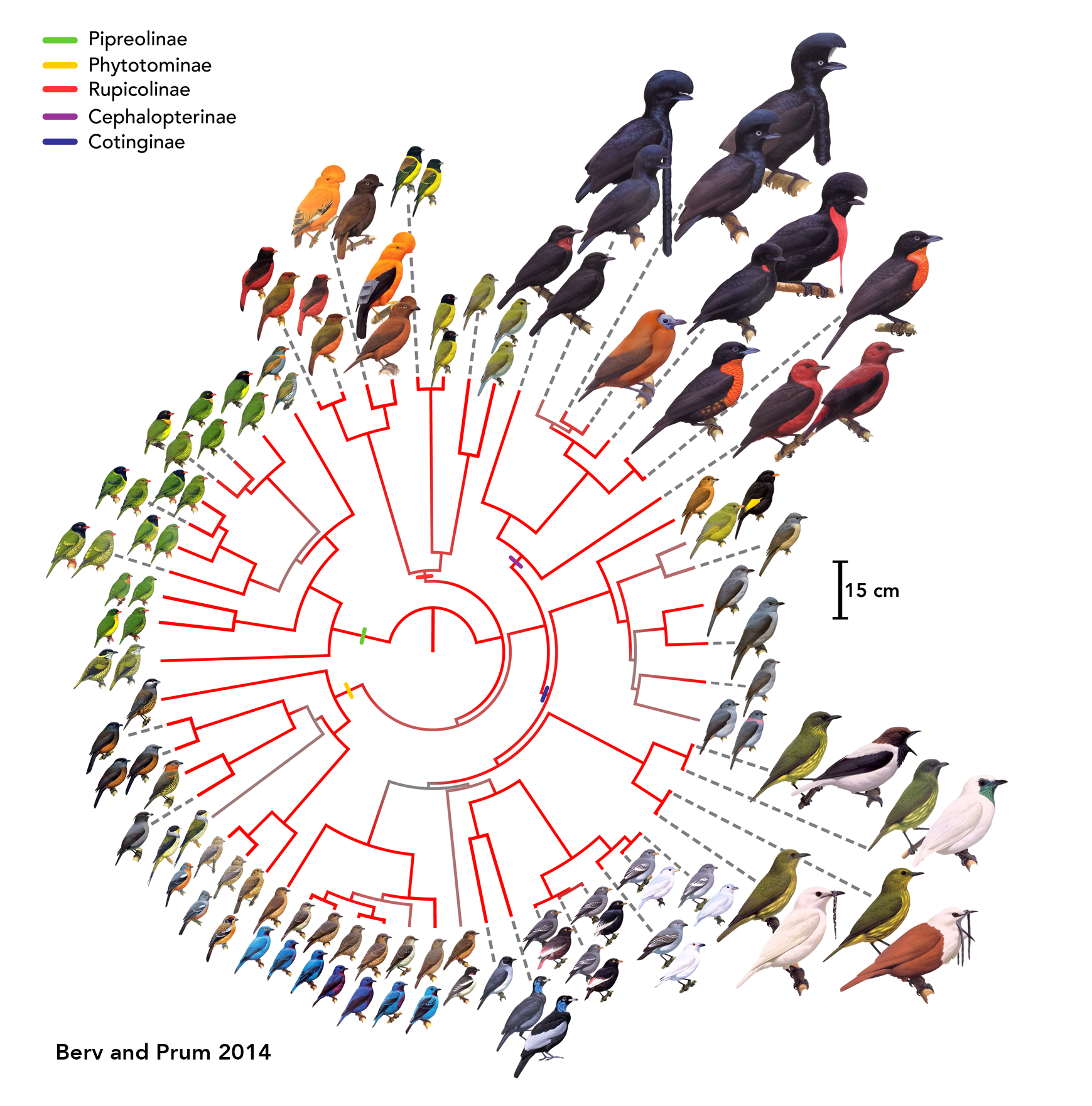
To test Darwin's (1871) hypothesis that stronger sexual selection under polygynous breeding systems promotes color dimorphism, we estimated and analyzed a new phylogenetic hypothesis for Neotropical Cotingas, a diverse clade of suboscine passerines known for elaborate plumage.
Sexual Selection: Feather Instruments in Bee Hummingbirds
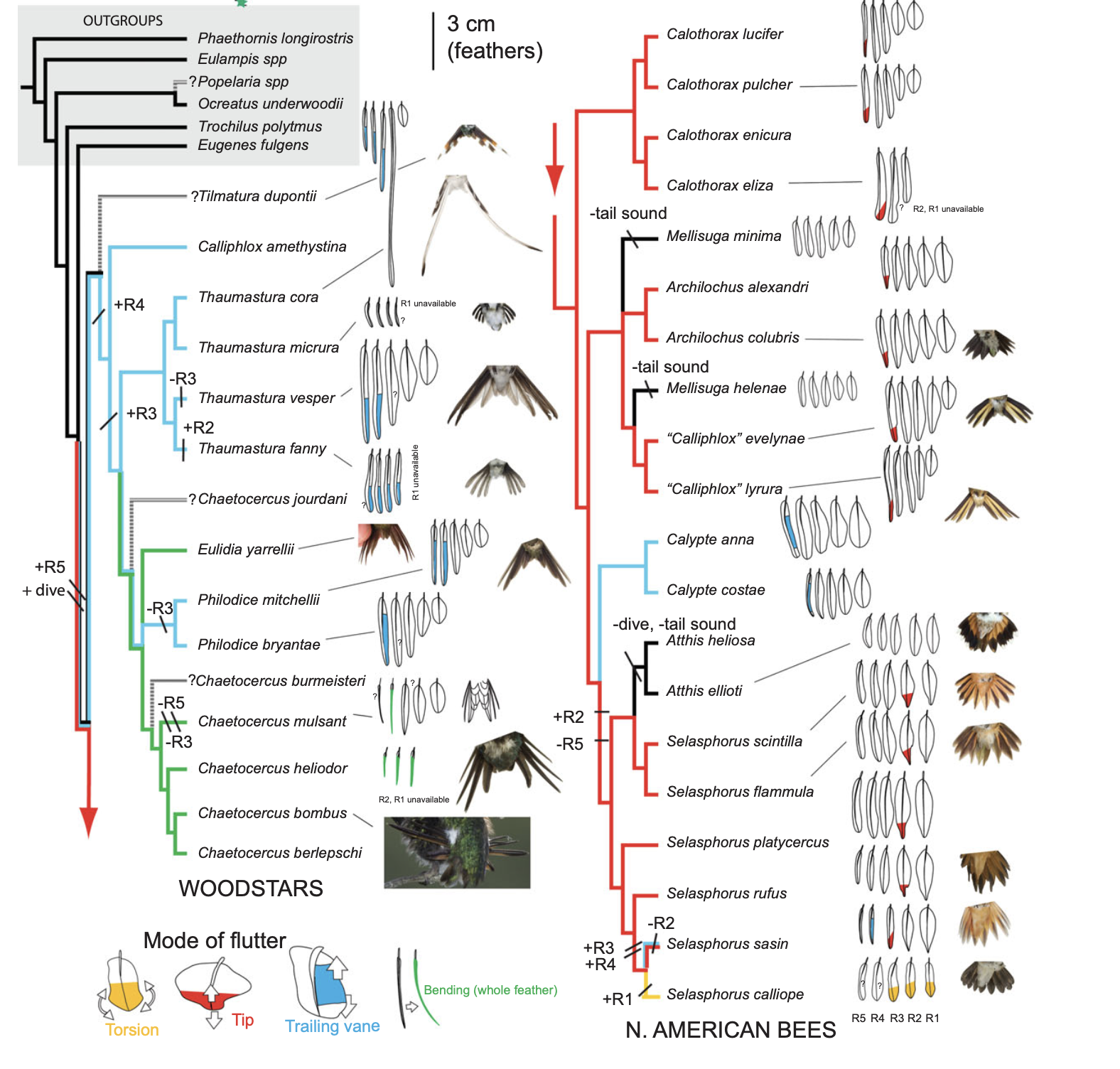
Phenotypic traits with complex physical bases often have complex evolutionary histories. Males in the bee hummingbird clade court females with tail-feather sounds produced during display dives. In this study, I used stochastic-process models to rank alternative evolutionary scenarios.
Vocal Phenotype in a Radiation of Manakins

To examine the evolution of a behavioral secondary sexual trait, I studied vocal diversification in a cryptic species complex across the Amazon basin. Alongside biogeographic results, this work uncovered complex patterns of symplesiomorphic character evolution.
Our genomic phylogeography supports an Andean-origin scenario with subsequent lowland diversification and identifies substantial introgression among some western Amazonian populations. These reticulate histories complicate standard tree-based inference but provide direct evidence that diversification in this complex includes both isolation and secondary contact.
- Most major genetic breaks coincide with known Neotropical dispersal barriers.
- Vocal variation is strongly structured: 14 distinct vocalization types, most lineage-diagnostic.
- A conservative interpretation supports at least 8 lineages; broader taxonomic implications suggest 15-17 species may have arisen in roughly 2.5 million years.
Fossil Reconstructions
Estimating Body Mass
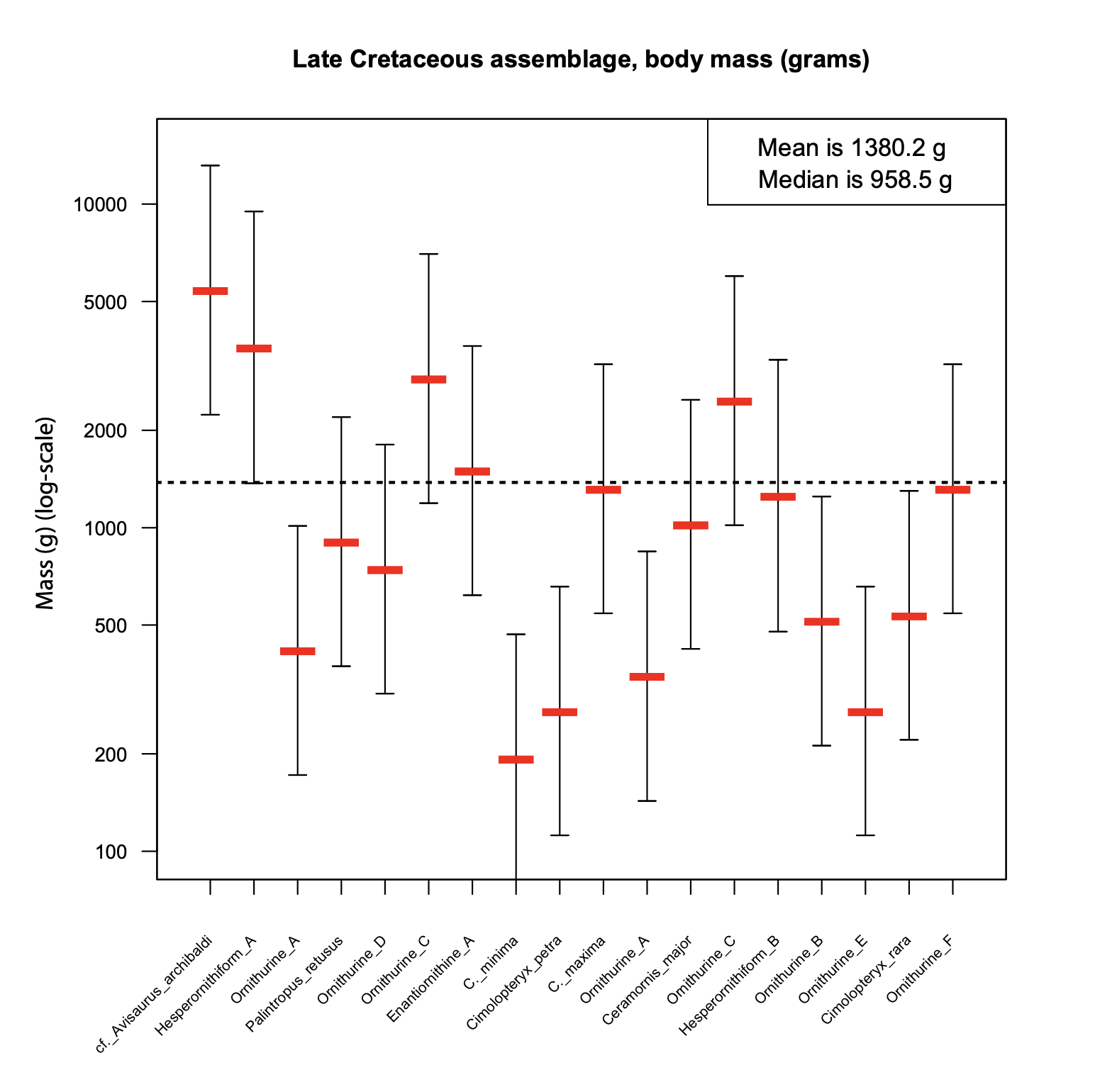
I am interested in how well we can reconstruct living characteristics from skeletal proportions, especially for taxa known only from fossils. Here, I use allometric scaling equations to estimate body-mass distributions for stem-lineage birds in the latest Maastrichtian.
In Berv and Field 2018 (Systematic Biology), we link these reconstruction efforts to molecular-rate dynamics across the avian tree. That study found strong associations between life-history traits and substitution-rate variation, with consequences for divergence-time inference near the K-Pg boundary.
- Across birds, estimated genomic rates show pronounced heterogeneity (up to about 20-fold).
- Substitution rate is strongly associated with body size and metabolic rate in comparative analyses.
- Simulation results indicate life-history-associated rate differences can produce large shifts in inferred clade ages (on the order of tens of millions of years; approximately 37.5 Ma in one neornithine comparison).
Fish Shape Evolution Across the Phanerozoic
In a recent preprint, Rivero-Vega et al. compare three canonical "living fossil" fish lineages—coelacanths, lungfishes, and holosteans—under a common analytical framework for both discrete characters and body-shape evolution.
- Lungfishes show highest discrete-character rates early (especially around the Devonian), followed by long-term decline.
- Coelacanths show multiple early peaks and strong evidence of declining rates toward the recent.
- Holosteans show modest peaks but broadly more stable rates through time, with mixed support for sustained decline in body-shape rates.
The core takeaway is that "living fossil" lineages do not share a single evolutionary mode: tempo and mode vary among clades and by data type, reinforcing the need for explicit quantitative tests rather than qualitative labels.